Workplace CCTV –
For many businesses in York, CCTV is no longer viewed purely as a security system. Increasingly, companies are using commercial CCTV to improve:
- Workplace safety
- Operational oversight
- Incident investigation
- Health and safety compliance
This leads to a growing question among employers: can CCTV actually help businesses improve health and safety standards?
In many commercial environments, the answer is yes. When used correctly, CCTV can become a valuable tool for identifying risks, supporting investigations and improving overall workplace accountability.
Why CCTV is becoming important for workplace compliance
Modern workplaces face increasing pressure to:
- Maintain safe environments
- Investigate incidents properly
- Demonstrate compliance procedures
- Protect both staff and visitors
Without clear evidence, many incidents become:
- Difficult to investigate
- Time-consuming to resolve
- Open to dispute or uncertainty
Commercial CCTV provides objective visual records that help businesses understand exactly what happened.
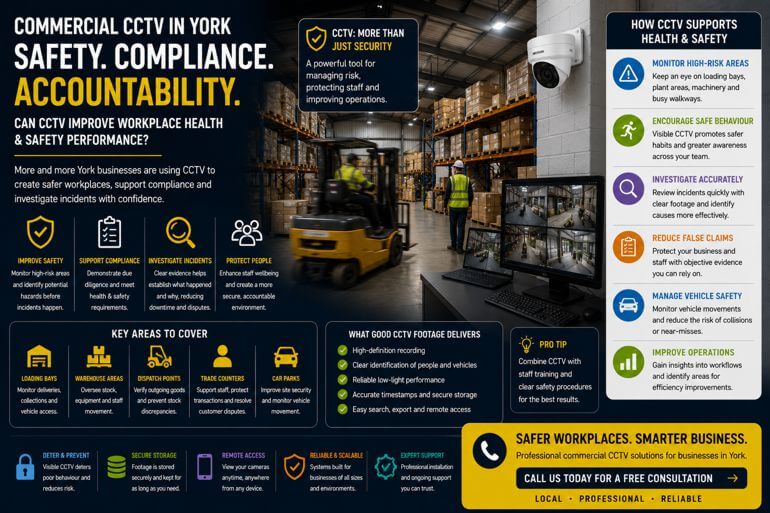
How CCTV supports health and safety
Commercial CCTV can help businesses:
Monitor high-risk areas
This includes:
- Loading bays
- Warehouses
- Vehicle movement zones
- Production areas
- Staff-only operational spaces
These are often the locations where accidents or near misses occur.
Investigate workplace incidents accurately
If an accident happens, CCTV footage can help determine:
- The sequence of events
- Whether procedures were followed
- Contributing environmental factors
This allows businesses in York to:
- Review incidents fairly
- Improve procedures where necessary
- Reduce future risk
Improve awareness of unsafe behaviour
Visible CCTV often encourages:
- Better adherence to procedures
- Improved awareness around equipment
- Safer operational habits
This can be especially useful in:
- Warehouses
- Industrial premises
- Trade environments
- Distribution facilities
CCTV supports vehicle and pedestrian safety
In commercial premises where:
- Vans
- Forklifts
- Deliveries
- Staff movement
all operate together, CCTV helps monitor:
- Traffic flow
- Blind spots
- Unsafe movement patterns
This improves both safety oversight and incident review capability.
Can CCTV help reduce false claims?
Yes.
Commercial CCTV can provide evidence relating to:
- Workplace accidents
- Public liability claims
- Staff disputes
- Customer allegations
This protects both:
- Businesses
- Employees
by ensuring incidents can be reviewed objectively.
What areas should workplace CCTV cover?
Effective systems commonly include:
- Entrances and exits
- Loading areas
- Shared operational spaces
- Reception areas
- Vehicle routes and car parks
Coverage should always be:
- Relevant
- Proportionate
- Professionally designed
Does footage quality matter?
Absolutely.
Commercial CCTV should provide:
- Clear HD or 4K recording
- Reliable low-light performance
- Accurate timestamps
- Consistent coverage quality
Poor-quality footage often becomes unusable when incidents need investigating.
Modern systems provide smarter incident review
Today’s CCTV systems often include:
- Smart motion search
- Human and vehicle detection
- Rapid footage export
- Remote access for management teams
This makes incident review much faster and more efficient.
CCTV works alongside safety procedures — not instead of them
It is important to remember that CCTV should support:
- Staff training
- Risk assessments
- Health and safety procedures
rather than replace them.
The best commercial environments combine:
- Good operational management
- Proper training
- Modern monitoring systems
Final Answer: Can CCTV improve workplace health and safety?
Yes — commercial CCTV can significantly improve:
- Incident investigation
- Workplace accountability
- Risk awareness
- Safety oversight
For businesses in York, modern CCTV systems provide far more than security alone. They help create:
- Safer workplaces
- Better operational visibility
- Stronger evidence when incidents occur
When professionally designed, CCTV becomes a valuable part of wider workplace safety and compliance management.