
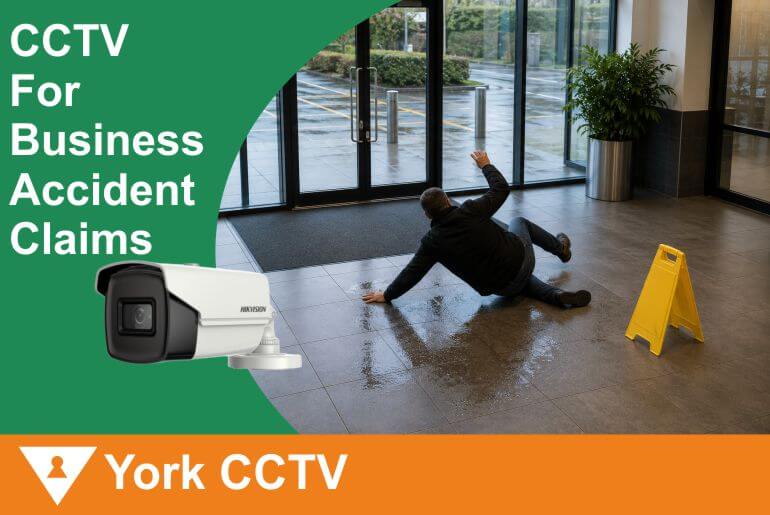
CCTV for business accident claims –
A customer reports slipping near an entrance. A visitor says they tripped in a corridor. A contractor claims an obstruction caused them to fall in an external service area.
For a business, incidents like these need to be taken seriously. However, establishing exactly what happened can sometimes be difficult, particularly when nobody witnessed the event or accounts differ.
This is one area where professionally installed commercial CCTV can provide valuable factual evidence.
Businesses throughout York welcome employees, customers, contractors and visitors onto their premises every day. Whether operating a shop, office, hospitality venue, warehouse or other commercial site, there is always the possibility that somebody will report an accident.
CCTV may help establish the circumstances surrounding that incident.
Consider a reported slip near a building entrance. The person involved may believe the floor was wet, while staff remember the area being dry. Suitable CCTV footage could show the conditions immediately before the incident, whether cleaning had recently taken place and how the individual fell.
Importantly, footage can support legitimate claims just as effectively as it can challenge inaccurate ones.
If a genuine hazard caused an accident, understanding exactly what occurred allows the business to address the problem and reduce the likelihood of somebody else being injured.
Trips provide another example.
A customer may report catching their foot on an object left in a walkway. CCTV could help determine whether an obstruction was present, how long it had been there and what happened immediately before the incident.
External areas can be equally important. Paths, steps, service yards and customer entrances experience changing conditions throughout the year. Rain, ice, fallen leaves and temporary equipment can all influence how these spaces are used.
Having appropriate CCTV coverage provides an additional source of evidence when reconstructing an event.
The usefulness of that evidence depends heavily on system design.
A camera providing only a distant overview may confirm that somebody fell but reveal little about why. Professional positioning aims to provide meaningful coverage of appropriate areas without unnecessarily monitoring locations where surveillance serves no legitimate purpose.
Image quality matters too.
Modern high-definition CCTV can provide considerably more detail than older equipment, helping authorised users understand the sequence of events rather than relying on indistinct images.
Timing is another important consideration.
If an incident is reported several days later, businesses need to know that relevant footage is still available. Recording capacity and retention arrangements should therefore reflect the organisation’s legitimate requirements and applicable data protection responsibilities.
Access to footage should also be controlled. Commercial CCTV recordings may contain employees, customers and members of the public, so businesses should have clear procedures governing who can review, retrieve and manage recordings.
CCTV can also reveal wider lessons following an accident.
Reviewing an incident may show that pedestrians regularly take an unexpected route through a car park, customers repeatedly encounter congestion near an entrance or deliveries temporarily obstruct a walkway.
The immediate footage answers the question of what happened, but the broader pattern may help prevent future incidents.
This makes CCTV valuable for risk management as well as conventional security.
Businesses should not assume that installing cameras removes the need for proper health and safety procedures. Regular inspections, good housekeeping and appropriate risk management remain essential. CCTV complements these measures by providing additional information when an incident requires investigation.
For York businesses, the key benefit is objectivity.
When somebody reports an accident, management should not begin by assuming the claim is either genuine or exaggerated. The priority is establishing the facts.
Witness statements, incident reports and physical evidence may all contribute to that process. Where appropriate footage exists, CCTV can provide another important piece of the picture.
Sometimes it will confirm precisely what the person reported. Sometimes it will reveal that events happened differently.
Either way, a professionally designed CCTV system can replace uncertainty with evidence – helping businesses respond fairly, investigate incidents properly and identify practical improvements that make their premises safer.